Mobile · 3D scanning · ERP commerce
PRIMESOLES
Custom orthopaedic insoles, ordered from home.
- iOS
- TrueDepth 3D
- Shopify
- Business Central
- Azure
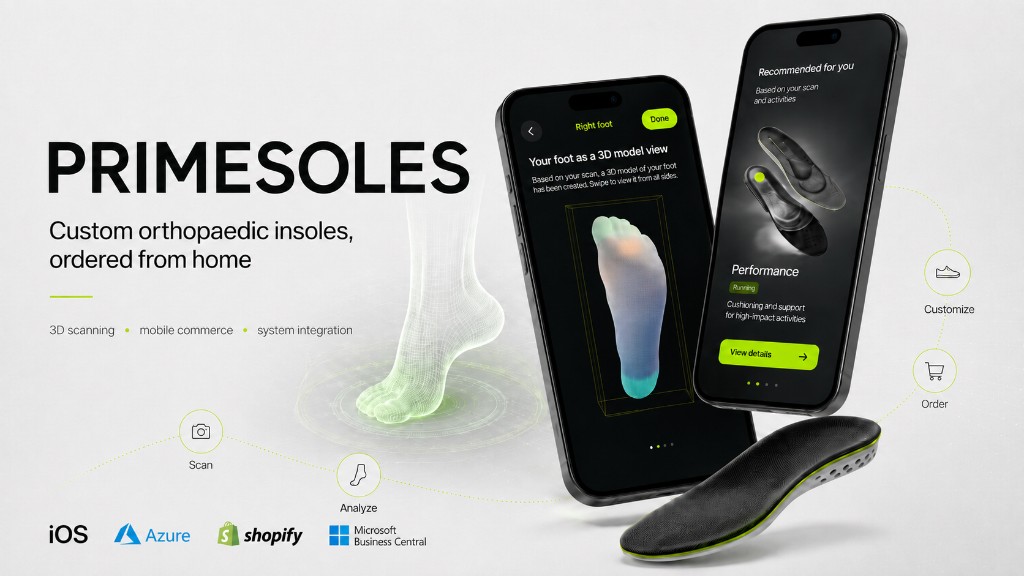
Product architecture · UX collaboration · Native mobile · Backend & systems integration
- Client
- PRIMESOLES GmbH
- Platform
- iPhone and iPad
- Scope
- Product architecture, UX collaboration, native mobile development, backend and systems integration
- Status
- Live on the App Store
- Engagement
- End 2025 – beginning 2026 (3 months core development)
- Responsibility
- Scanning mobile app, ERP integration, backend development with the PRIMESOLES in-house team
Gallery
A mobile product that lets customers scan their feet, describe everyday movement, receive suitable recommendations and place an order — without first travelling to a specialist scanning location.
The opportunity
A precise understanding of the customer’s foot profile is fundamental to creating a suitable orthopaedic insole.
Traditionally, PRIMESOLES captured this information using dedicated scanning hardware, with a scanning employee travelling to the customer to scan each person’s feet. The process worked well wherever that equipment was available, but it placed a natural limit on who could access the service and where an order could begin.
PRIMESOLES saw the opportunity to bring the first part of that experience into the customer’s home. Their ambition was not simply to add a mobile storefront. They wanted customers to create a meaningful digital foot profile, provide the contextual information required for a suitable recommendation and move naturally into the existing ordering and production process.
The task was therefore both physical and digital: translate a specialist measurement workflow into an interaction that ordinary customers could perform confidently with a phone.
Seeing the product as a whole
The initial request centred on a scanning application. But the usefulness of the application depended on everything surrounding the scan.
A complete customer journey would need to identify or provision the user; guide them through capturing both feet; process and securely retain the resulting scan data; collect information about shoes and everyday activities; account for existing insoles where relevant; recommend appropriate PRIMESOLES products; create or connect the customer and their order; and make the resulting data available to the systems supporting fulfilment and production.
We therefore began by mapping the full service rather than treating the app as an isolated interface.
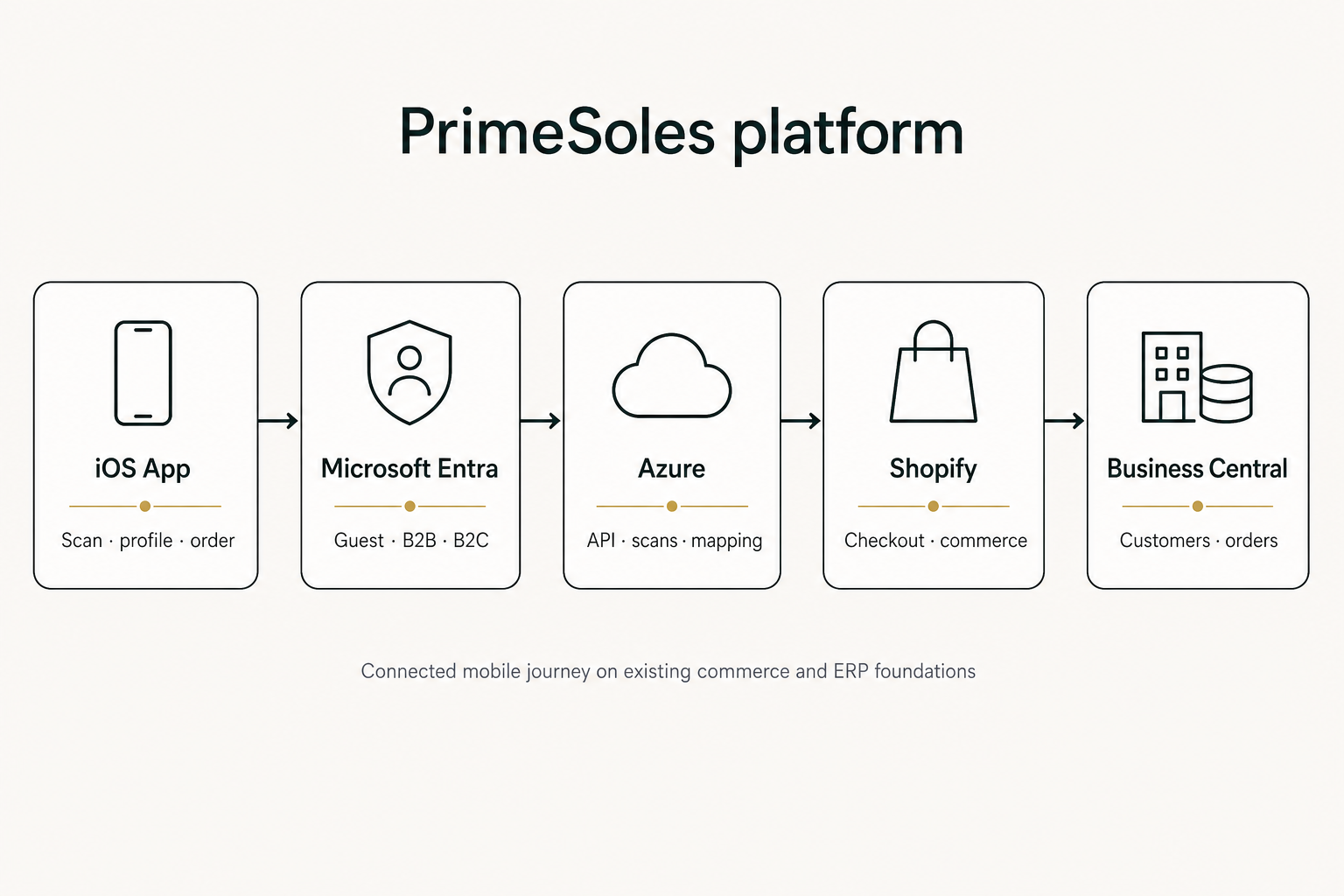
The resulting architecture connected the native mobile application with Shopify, Microsoft Business Central and a purpose-built backend in Microsoft Azure. An external identity tenant supported customer authentication, while the backend orchestrated scan data, order events, PDFs and the mappings required to keep customers, scans and purchases connected across systems.
This early system framing allowed the visible experience to remain focused and simple while giving PRIMESOLES an operational foundation that could support private customers, business customers and guest users.
Designing a five-second foot scan
The defining interaction was the foot scan itself.
The experience needed to capture sufficiently detailed depth information while asking the customer to hold an unfamiliar position: placing the phone safely on the floor and positioning a foot above the camera.
Long capture times would make that physical interaction uncomfortable. Complex instructions would create uncertainty. Weak feedback would leave customers unsure whether the scan had succeeded.
We designed the flow around a brief, guided capture:
- The app first shows a how-to to prepare the customer for the scan.
- The customer places the device on the floor.
- The application detects when the foot enters the scanning area (~25–50 cm above the front-facing camera).
- Clear visual feedback helps the customer hold the required position. Once the foot is in frame for three seconds, the scan starts.
- Depth information is captured over two seconds.
- The data is filtered and processed into a clean digital foot profile.
For the main foot capture, we used Apple’s front-facing TrueDepth system rather than assuming the rear LiDAR sensor would provide the best result. Three reasons drove that choice:
- TrueDepth offers higher fidelity than the LiDAR sensor for this use case.
- With the phone on the floor, customers can see real-time feedback on screen while hovering their foot over the device.
- Only the foot moves while the phone remains static — far more reliable than LiDAR approaches where the user moves the phone around a foot held in the air.
The scan itself takes approximately five seconds per foot, turning a technically sophisticated process into a short moment within the larger customer journey.
From raw depth data to a useful foot profile
Capturing depth information was only the beginning.
Mobile depth data can contain incomplete surfaces, noise and artifacts caused by movement, lighting, distance and the surrounding environment. The application therefore processes the captured information on-device before presenting or transmitting the resulting model.
The pipeline filters irrelevant geometry, reduces scanning artifacts and refines the boundaries of the foot profile. The goal is not simply to display an impressive 3D object, but to produce information that is useful within PRIMESOLES’ downstream workflow.
Once complete, customers can inspect the resulting digital representation before continuing. The 3D model is later uploaded to Azure when the order is placed.
Accounting for more than the shape of a foot
A suitable insole depends on more than geometry alone.
After completing the foot scan, customers provide information about their foot, leg and back health, their shoes and the contexts in which they expect to use the product. The application presents activity categories such as running, hiking, work, leisure and several sports, allowing the recommendation journey to reflect everyday needs.
Customers who already use insoles can also capture them through a separate augmented-reality scanning process using LiDAR. Measuring length and width gives PRIMESOLES additional context about the customer’s current setup and can help inform the new product.
The application then recommends suitable products and allows customers to select quantities before continuing into checkout.
This flow connects three kinds of understanding: the physical profile of the customer’s feet; the products or supports they already use; and the life they expect the new insoles to support.
One experience for several kinds of customer
PRIMESOLES serves both private customers and organisations. The application therefore needed to accommodate multiple access models without becoming confusing.
A private customer may create an account or begin as a guest. An existing business customer may need to be recognised through customer data already held in Microsoft Business Central. Each route affects the information available, the language shown and the way the resulting order is associated with the correct account.
We developed an identity and token model that allows guest users to move securely through the scanning and ordering flow while supporting authenticated customer experiences where needed.
The interface adapts to the customer context, but the essential journey remains coherent: scan, describe, select and order.
Connecting the customer journey to the business
The visible mobile interface is only one part of the product.
Shopify provides commerce and order handling. Microsoft Business Central remains the operational source for customer and order information. The Azure backend — co-developed with PRIMESOLES — connects these systems with the scanning application and the associated scan assets.
When an order is placed, order events are passed to the backend. The system maintains the relationship between the relevant customer, order and scan, while scans and generated documents are stored separately from structured operational data.
The result is not an app that creates another isolated data silo. It is a customer-facing layer connected to the systems PRIMESOLES already uses to run its business.
Crafting confidence into the interface
The experience asks customers to perform actions they may never have attempted before: positioning a device on the floor, holding a foot above a camera and scanning an existing insole.
That meant usability could not be treated as a final layer added after the technical work. It was central to whether the product would succeed.
Together with PRIMESOLES, we refined the journey around prominent step-by-step navigation; visual demonstrations of unfamiliar actions; automatic foot detection; clear confirmation when a capture is complete; focused screens with one primary task; activity-led product selection; and a consistent visual language derived from the PRIMESOLES brand.
The vivid green device frames and restrained interface give the product a recognisable identity, while the flow gradually introduces complexity rather than exposing the complete process at once.
The final visual design was developed in collaboration with PRIMESOLES: they defined the design language, animations and wireframes for most screens, and JCR followed that pattern for the remaining ones.
Collaboration as part of the product
The application evolved through close, direct collaboration with PRIMESOLES.
Rather than treating the initial specification as fixed, we worked through technical discoveries and design decisions together. Requirements were translated into working increments, reviewed in context and adjusted as the real interaction became clearer.
JCR led the system architecture and development — framing the system, assessing scanning technologies, identifying integration requirements, surfacing trade-offs and proposing solutions as new questions emerged. Examples include the AR flow to measure existing insoles, the architecture to sync existing customers with the identity provider in Azure, and the UX for fast, efficient foot scans. The whole project was delivered within six months, with three months of core development time.
That collaborative rhythm was particularly important in a product where physical movement, mobile hardware, backend data and an established business process all had to work as one experience.
The outcome
PRIMESOLES now has a publicly available mobile product through which customers can create a personal foot profile, scan existing insoles, identify relevant activities, receive product recommendations and begin the ordering process remotely.
For the customer, a process once tied to dedicated physical equipment becomes accessible through a familiar device.
For PRIMESOLES, the product creates a new digital entry point into its existing commerce and operational ecosystem rather than a disconnected experiment.
For JCR, the project brought together several of the capabilities at the heart of our work: product architecture, advanced mobile interaction, applied 3D technology, human-centred design and the careful integration of systems that need to function beyond the demo.
What PRIMESOLES says
“Julius and JCR Technologies developed our PRIMESOLES app, and we are more than satisfied with the result. From the beginning, the collaboration was straightforward, fast and completely solution-oriented. Julius did not simply implement our requirements. He consistently thought ahead, contributed his own ideas and found an appropriate solution for every challenge. Communication was reliable and at eye level, and requested changes were implemented quickly. Our app is modern, functional and exactly what we had envisioned. A clear recommendation for anyone looking for an engaged and highly capable technology partner.”